The BRRR strategy sounds simple on paper: buy a distressed property, rehab it, rent it out, refinance to pull your capital back, and repeat. Five steps. Easy, right?
Until you’re three months into a rehab with a contractor who’s over budget, you have no idea what your actual ARV is going to appraise at, and your lender is asking for six months of seasoning before they’ll even look at your refinance application. That’s when the “simple” BRRR strategy starts to feel like a full time job you didn’t sign up for.
The investors who consistently execute profitable BRRR deals aren’t smarter or luckier. They track everything. Rehab costs to the dollar. ARV comps updated monthly. A refinance checklist they’re working toward from day one. Here’s exactly how they do it.
Your Rehab Budget Is the Deal
Most BRRR deals don’t fail at acquisition. They fail during rehab. Scope creep, surprise foundation issues, a contractor who disappears for two weeks, materials that cost 30% more than your initial estimate. The rehab phase is where your equity gets created or destroyed.
The 70% rule is still the gold standard for BRRR acquisitions in 2026: never pay more than 70% of the after repair value minus rehab costs. But that rule only works if your rehab estimate is accurate. If you budget $25,000 for a rehab and it actually costs $40,000, you just turned a deal with 25% equity into one with 10%.
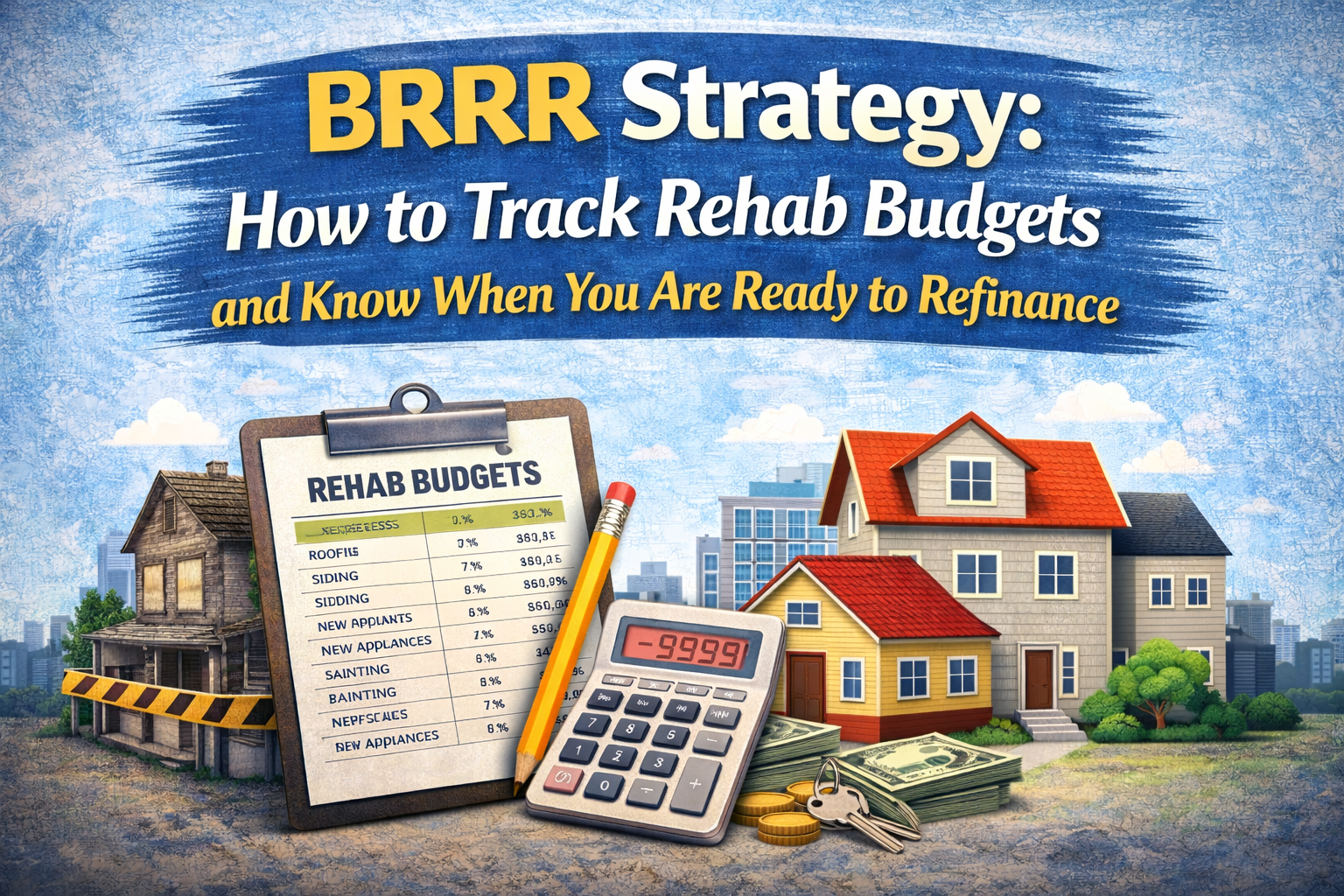
Here’s what a real rehab budget tracker should include for every property:
Line item categories: Break every rehab into specific scopes. Roof, HVAC, plumbing, electrical, flooring, paint, kitchen, bathrooms, exterior, landscaping, permits, and a contingency line. If you’re lumping everything into “rehab costs,” you’re flying blind.
Estimated vs. actual columns: Every line item needs what you budgeted and what you’ve actually spent. The gap between those two numbers is where deals go sideways. Track it weekly, not monthly.
Contractor payments with dates: Log every payment, who it went to, and what it covered. You need this for your tax records (Schedule E, anyone?), for your refinance appraisal, and for your own sanity when the contractor says he already got paid for the plumbing.
A 10 to 15% contingency: In 2026, materials costs remain volatile. If your rehab estimate is $30,000, budget $33,000 to $34,500. If you don’t use the contingency, congratulations, your deal just got better. If you do, you planned for it.
Photo documentation: Before, during, and after photos for every major scope item. Your appraiser will want to see what changed. Your lender may ask. And if you ever have a dispute with a contractor, photos are your evidence.
Three Numbers That Tell You Where Your Deal Stands
At any point during a BRRR deal, you should be able to answer three questions instantly:
1. What’s my total investment? This is purchase price plus closing costs plus all rehab spent to date plus holding costs (insurance, taxes, utilities, loan payments during rehab). If you can’t state this number within 60 seconds, you’re not tracking closely enough.
2. What’s my current ARV estimate? Pull comps every 30 days during the rehab. Markets move. Your ARV in month one might not be your ARV in month six. Look at sold comps within a half mile, similar square footage and bedroom/bathroom count, sold in the last 90 days. Be conservative. Your appraiser will be.
3. What’s my projected equity position? This is the gap between your ARV and your total investment. If your ARV is $120,000 and your total investment is $85,000, you’re sitting on $35,000 in equity, or about 29%. That number tells you exactly how much room you have in your refinance, and whether this deal will return most of your capital or leave a chunk trapped.
When Are You Actually Ready to Refinance?
“I’ll refinance when the rehab is done” is not a strategy. You need to hit specific milestones before a lender will approve a cash out refinance on a BRRR property. Here’s the checklist:
Seasoning period met: Most lenders require 6 to 12 months of ownership before they’ll do a cash out refinance. DSCR lenders (the most common for BRRR investors) typically require 6 months minimum. Start counting from your closing date, not your rehab completion date.
Property is tenant occupied and rent is verified: Lenders want to see that the property is generating income. For DSCR loans, the rent is the qualifying factor, not your personal income. They’ll compare your gross rent against the proposed mortgage payment (principal, interest, taxes, insurance). Most DSCR lenders want a ratio of 1.0 or higher, meaning rent covers the full payment. A ratio of 1.20 to 1.25 gives you a much stronger application.
Your equity position supports the LTV: In 2026, most DSCR lenders cap cash out refinances at 75% to 80% loan to value. That means if your property appraises at $120,000, the maximum loan is $90,000 to $96,000. If your total investment was $85,000 and you get a $90,000 loan, you’re getting $5,000 back (minus closing costs). If you get $96,000, you’re pulling back $11,000. This is why your acquisition price and rehab budget matter so much. Every dollar over budget is a dollar you don’t get back in the refinance.
Credit score of 660 or higher: DSCR lenders typically require a minimum 660 FICO. Higher scores get better rates. With investment property cash out refinance rates running 7.0% to 7.75% in late 2025 and early 2026, every fraction of a point matters for your monthly cash flow.
Cash reserves documented: Lenders want to see that you have 3 to 6 months of mortgage payments in reserve. If your new payment will be $750/month, have at least $2,250 to $4,500 sitting in a verifiable account.
The “Perfect BRRR” Is a Myth (And That’s OK)
The perfect BRRR, where you get 100% of your capital back at refinance, is rare in 2026. Higher interest rates and conservative LTV caps mean most investors are leaving 5 to 10% of their initial investment in each deal. That’s not a failure. A BRRR deal where you invest $85,000, create $35,000 in equity, get $75,000 back through refinance, and keep a property cash flowing $200/month on a Section 8 lease is a win. You deployed $10,000 in trapped capital and now own an asset generating passive income.
The investors who struggle are the ones who don’t know their numbers. They can’t tell you their total investment, their current equity position, or how close they are to meeting refinance requirements. They track everything in their head, or worse, in a spreadsheet they update once a quarter.
What This Looks Like in Practice
Imagine you just bought a 3 bed / 1 bath in Birmingham for $55,000. Your rehab estimate is $28,000. Your ARV based on comps is $115,000. Here’s how you’d track the deal:
Total acquisition cost: $55,000 + $3,200 closing = $58,200. Rehab budget: $28,000 + 12% contingency = $31,360. Holding costs (6 months): $4,800. Total projected investment: $94,360. ARV: $115,000. Projected equity: $20,640 (18%). At 75% LTV refinance: loan of $86,250. Cash back: $86,250 minus payoff of $55,000 purchase loan = $31,250. Capital left in deal: $94,360 minus $55,000 (paid off by refi) minus $31,250 (cash back) = $8,110. That’s 8.6% of your capital left in a property that will cash flow $250/month on a Section 8 voucher. In 33 months, the cash flow alone pays back your remaining capital.
Tracking these numbers from the moment you close, and updating them weekly through rehab, is the difference between knowing you have a profitable BRRR and hoping you do.
Stop Guessing, Start Tracking
The BRRR strategy works in 2026. But it works for investors who treat their rehab budgets like a living document, who know their refinance requirements before they even close on the purchase, and who can pull up their equity position at any moment.
If you’re still tracking your BRRR deals in a spreadsheet you built at 2am, or worse, keeping it all in your head, you’re making it harder than it needs to be.
Track every deal from purchase to refinance. → Try DoorVault free