The 1031 Exchange Fundamentals
A 1031 exchange (named after Section 1031 of the Internal Revenue Code) is one of the most powerful tax tools available to real estate investors. It allows you to defer federal income taxes on the sale of a rental property—potentially indefinitely—by reinvesting the proceeds into another “like-kind” property.
Here’s the core concept: Sell Property A today. Instead of paying capital gains taxes on your profit, you take those proceeds and invest them into Property B. If done correctly, you owe zero federal tax on the sale. You’ve deferred your entire tax liability to the future—or until you eventually sell without doing another 1031 exchange.
For an investor with significant equity in underperforming properties, a 1031 exchange is the mechanism that makes portfolio optimization tax-efficient.
The Basic Rules You Must Know
Before diving into the coordination challenge, you need to understand the non-negotiable timeline:
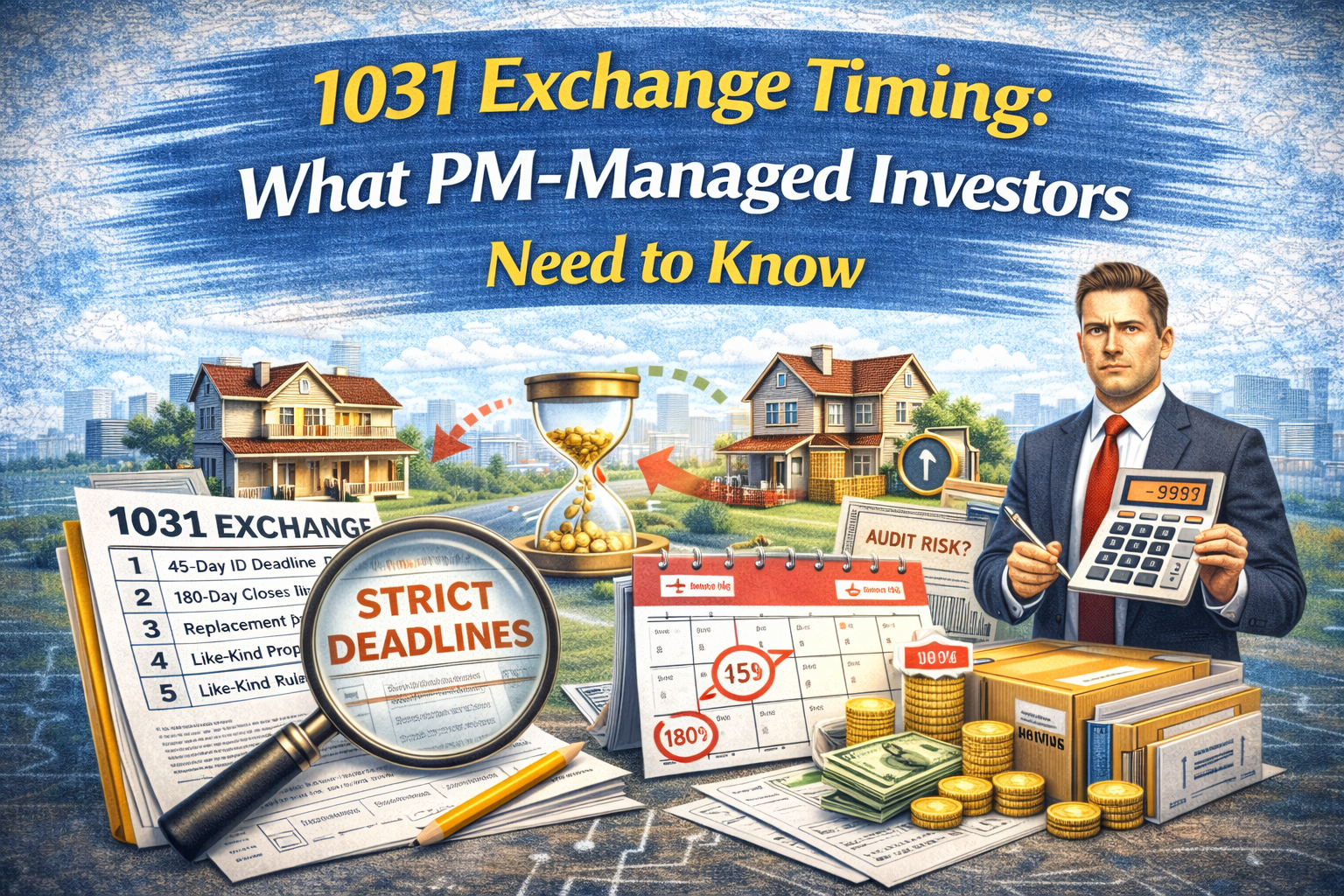
The 45-Day Identification Period: Once you close the sale of your relinquished property (the one you’re selling), you have exactly 45 calendar days to identify potential replacement properties. This isn’t 45 business days—it’s 45 calendar days, and weekends count. Miss this deadline by even one day, and your exchange is invalid.
The 180-Day Closing Period: Within 180 calendar days of closing your sale, you must have actually closed (not just identified or entered into contract) at least one of the replacement properties. Again, this is a hard deadline. There are no extensions.
Like-Kind Property: Federal tax law defines like-kind very broadly for real estate. Any real property can be exchanged for any other real property, regardless of type. An apartment building can be exchanged for a single-family home. Raw land can be exchanged for a commercial building. Geographic location doesn’t matter. This flexibility is one reason 1031s are so powerful.
Qualified Intermediary Requirement: You cannot touch the proceeds from the sale. A qualified intermediary (QI)—a third party—must hold the sale proceeds. If you touch the money, the IRS treats it as a taxable event, and you lose the deferral. This is absolute.
Why PM-Managed Investors Face Unique Timing Challenges
If you self-manage your rental properties, executing a 1031 exchange is already complex. You’re managing the sale, identifying replacements, and coordinating with your CPA while handling it all yourself.
But when you’ve hired a property manager, you introduce another stakeholder—and that stakeholder’s timeline might not align perfectly with your 1031 decision.
Here’s the reality: Your PM manages operational tasks. They don’t manage your capital decisions. That’s your job. But executing a 1031 requires your PM’s participation, even though they may have competing priorities.
The Property Manager’s Role in a Disposition
When you decide to sell a property in your PM-managed portfolio, your PM becomes responsible for a series of operational steps:
1. Preparing the Property for Market
Your PM must assess the current condition of the property. Are there repairs needed before listing? Cosmetic improvements that will increase market appeal? Some property managers are proactive about this; others wait for your instruction.
2. Managing Tenant Move-Out (If Applicable)
If the property is tenant-occupied, your PM must facilitate the tenant’s departure. They handle notice requirements, lease compliance, security deposit returns, and the move-out inspection. In some markets, this can stretch weeks or months depending on lease terms and local tenant protections.
3. Marketing and Showings
Once the property is vacant and market-ready, your PM typically coordinates with a real estate agent. They may handle some showings themselves, manage contractor access, or respond to inquiries. The speed of marketing depends on the market, property condition, and pricing strategy.
4. Coordination with Your Real Estate Agent
Your PM and your chosen listing agent need to work together seamlessly. If they don’t communicate well, or if your agent is unfamiliar with your PM’s processes, you lose momentum.
The issue: All of this takes time. Getting a tenant out, completing repairs, and properly marketing a property usually takes 30-60 days minimum—and that’s in a cooperative scenario.
If you’ve just sold Property A and started your 45-day clock, you might only have 15 days left to close Property B while your PM is still completing the disposition logistics. This timing squeeze creates stress and sometimes forces suboptimal decisions.
The Coordination Challenge: Aligning Four Stakeholders
Executing a 1031 exchange with a hired property manager requires coordination among four parties, each with different roles and incentives:
Your Property Manager
- Responsible for marketing the relinquished property and managing the sale process operationally
- Needs clear timeline expectations upfront
- May resist aggressive timelines if it conflicts with their normal operational cadence
Your Qualified Intermediary
- Holds the sale proceeds in trust
- Tracks your 45-day and 180-day deadlines (though the responsibility for meeting deadlines falls on you)
- Cannot advise you on which properties to buy; they’re purely administrative
- Requires detailed documentation and accurate closing information
Your CPA/Tax Professional
- Advises on the tax implications of the specific replacement properties
- Helps identify properties that qualify for 1031 treatment
- Tracks depreciation recapture taxes and other post-exchange tax consequences
- Prepares documentation for your tax return
Your Real Estate Agent
- Responsible for marketing the relinquished property and negotiating the sale
- Helps identify and coordinate on replacement properties within your 45-day window
- Needs to understand the 1031 timeline and work within those constraints
The central problem: These four parties don’t all work for you. Your PM has other clients. Your real estate agent is juggling multiple listings. Your QI is handling exchanges for dozens of investors. Your CPA has a practice full of clients.
For your 1031 to execute smoothly, all four must prioritize your timeline. This requires you to communicate clearly, upfront, about deadlines and expectations.
Strategic Decision-Making: Which Property Should You Exchange?
Before managing the operational logistics, you need to answer the fundamental question: Which property in your PM-managed portfolio should you sell?
This is where many investors make poor decisions. They sell the property that’s easiest to sell or has been in their portfolio longest, not necessarily the property that’s dragging down their returns.
Using Portfolio Performance Data to Make Informed 1031 Decisions
Your property manager sends monthly statements, but those statements are property-focused, not comparative. They don’t tell you how one property performs relative to another.
To make a strategic 1031 decision, you need to see your portfolio holistically:
-
Which property has the lowest cash-on-cash return? This might not be the one with the highest gross rent—it might be the one with the highest PM fees relative to output or the most costly maintenance issues.
-
Which property has the worst maintenance history? A property that requires constant repairs is a drag on your returns and mental bandwidth. That might be your candidate for exchange.
-
Which property is underperforming relative to your original acquisition thesis? Maybe you bought it expecting 8% cash-on-cash return, but it’s delivering 4%. That’s not a property to hold indefinitely.
-
Which property has accumulated the most unrealized gain? If Property A has appreciated $200k and Property B has appreciated $50k, you have more flexibility in deciding which to exchange from a tax perspective (though you still owe capital gains tax on the one you sell).
-
Which property has hit the market cycle inflection point? If your local market has appreciated significantly and you’re thinking about trimming exposure to a particular asset class or geographic area, a 1031 allows you to shift into a better-performing market without triggering capital gains taxes.
This data-driven approach prevents emotional decision-making. You’re not selling the property you’re tired of managing or the one with the tenants you don’t like. You’re selling the one that your portfolio metrics say should be redeployed.
Tools like DoorVault help here by aggregating performance data across your PM-managed portfolio. Instead of manually comparing statements from three different property managers, you see a unified dashboard showing cash-on-cash returns, maintenance cost trends, and performance rankings. When you’re deciding whether to 1031 exchange Property A or Property B, you’re making the decision based on actual data, not intuition.
The Timeline: A Realistic Walkthrough
Let’s walk through a realistic 1031 exchange timeline to show where PM coordination matters most.
Month 1: The Decision Phase (Before Any Action)
You decide that Property A (currently underperforming) should be redeployed. You notify your PM and your CPA of your intent.
What’s critical: Your PM needs adequate notice. Ideally, 60-90 days before you want the property on market. This gives them time to prepare the property, arrange for tenant move-out, and coordinate with a real estate agent. If you spring this on them with 2 weeks’ notice, the disposition becomes rushed and might fetch a lower sale price.
Month 2: Pre-Marketing Phase
Your PM coordinates any necessary repairs or cosmetic improvements. Tenants are given notice of the impending sale and lease end dates. The property is readied for market.
Your real estate agent is brought into the loop. They conduct a market analysis, price the property, and prepare marketing materials.
What’s critical: Your CPA should be reviewing comps and estimated sale price to help you understand your potential capital gains and the approximate net proceeds you’ll have to invest in a replacement property.
Month 3: Marketing and Sale
Property A hits the market. The clock hasn’t officially started yet—the 45-day and 180-day periods begin only when you close the sale. Your PM, real estate agent, and any other parties facilitate showings and negotiations.
After 30-60 days of marketing (depending on market conditions and price), you accept an offer.
What’s critical: Before you close this sale, you must have identified and contacted a qualified intermediary. Your QI needs to be in place before you close. You cannot take possession of the sale proceeds yourself, even for a moment.
Day 1 (Sale Close): The Countdown Begins
You close the sale of Property A. Your proceeds go directly to your qualified intermediary’s trust account. The 45-day and 180-day clocks start running.
Your CPA and real estate agent immediately begin identifying replacement properties that fit your investment criteria and are available within the 45-day window.
What’s critical: You must identify properties in writing to your QI by day 45. You can identify up to three properties of any value, or you can identify more than three properties if their combined value doesn’t exceed 200% of the relinquished property’s sale price (the “200% rule”).
Days 1-45: The Identification Period
This is high-intensity work. Your real estate agent is sourcing replacement properties. You and your CPA are evaluating them against your investment criteria. You’re checking market conditions in target geographic areas. You’re potentially negotiating purchase agreements.
Your PM might be involved here if one of the replacement properties is in their geographic area or if you want them to comment on operational feasibility.
What’s critical: Don’t waste the first 20 days of this period being indecisive. Use the first two weeks to narrowly target your geographic markets and property types. Use days 15-40 to actively negotiate on identified properties. Make identifications by day 40 to leave a 5-day buffer before the hard deadline.
Days 45-180: The Closing Period
By day 45, you’ve identified your replacement properties. Now you’re closing them. You’re working with sellers, obtaining financing, doing inspections, and crossing your final closing date before day 180.
This is where your PM might re-engage if you’re acquiring properties in their market. They might provide insight into the properties, market conditions, or operational expectations.
What’s critical: If you identified multiple properties, you only need to close one. But the proceeds from the sale must go toward the purchase price of the replacement properties. You cannot pocket any proceeds.
Day 180: The Final Deadline
By this day, you must have closed the purchase of at least one replacement property. All sale proceeds (minus the QI fee and any accrued interest) go toward the purchase price of the replacement property.
After day 180, your 1031 exchange is complete (from a deadline perspective). You now own the replacement property, and your capital gains tax on the sale of Property A is deferred.
Practical Coordination: Pre-Exchange Communication
The success of your 1031 exchange hinges on clear communication before you take action. Here’s what you should do:
Notify Your PM First
Tell your PM: “I’m considering a 1031 exchange. Property A is a candidate. What’s your timeline for preparing it for market? How long would you estimate it takes from our decision to actual listing?” This gives you realistic expectations from the person who knows the operational timeline.
Brief Your CPA
Your CPA should understand your 1031 strategy. If you’re targeting specific geographic markets or property types, brief them now. They can advise on tax efficiency of different replacement property choices and help you understand your capital gains liability on the sale.
Identify a QI
Don’t wait until day-before-close to identify your qualified intermediary. Interview potential QIs now. Understand their fee structure, timeline for processing documentation, and reputation for meeting deadlines. A good QI is worth the cost—a slow one costs you time and stress.
Align Your Real Estate Agent
If you’re selling with one agent and buying with another, make sure both understand the 1031 timeline and constraints. Your selling agent needs to know you’re on a clock; your buying agent needs to understand the qualified intermediary requirement.
Common Pitfalls That Derail 1031 Exchanges
Even with good coordination, several mistakes can torpedo a 1031 exchange:
1. Missing the 45-Day Identification Deadline
You close on day 1. You’re busy. Days pass. You think you still have time. By day 43, you realize your ideal replacement property won’t work, and you haven’t formally identified anything. Missing day 45 is catastrophic—your entire exchange is invalid, and you owe capital gains taxes.
Prevention: Mark your calendar. Identify properties by day 40 at the latest, with a 5-day buffer.
2. Constructive Receipt
You close the sale, and the proceeds are wired to your bank account “temporarily” while you figure out your next move. The IRS considers this constructive receipt—you have control of the money, even if you haven’t personally claimed it. Constructive receipt disqualifies your exchange.
Prevention: Insist that proceeds go directly to your QI. Never touch the money.
3. Failing to Account for Accumulated Depreciation Recapture
You sold Property A for a $150k gain. You think a 1031 eliminates all tax. But you’ve been depreciating that property for 15 years, claiming $90k in depreciation deductions. When you sell, you owe “depreciation recapture” tax at 25% federal rate on the depreciated amount, regardless of whether you do a 1031.
A 1031 defers capital gains tax but not depreciation recapture. Plan for this tax bill.
Prevention: Ask your CPA to calculate your depreciation recapture liability before you commit to the exchange.
4. Not Exchanging Enough Value
You sell Property A for $300k (with $100k in proceeds after paying off the mortgage). You identify and purchase a replacement property for $200k, using only $100k of your 1031 proceeds.
That extra $100k is taxable. You’ve created “boot”—proceeds that weren’t reinvested in like-kind property. You’ll owe capital gains tax on that $100k, plus the depreciation recapture mentioned above.
Prevention: Reinvest the full proceeds into replacement property. If you want a lower-value property, use non-1031 funds or refinance a different property to pull cash for the down payment.
5. Blowing Timeline Due to Poor PM Coordination
Your PM takes 90 days to get Property A market-ready. You finally list on day 90. It sells after 30 more days. You close on day 120 with only 60 days remaining in your 180-day period. Finding and closing a replacement property in 60 days is extremely tight. A deal falls through, and you miss the deadline.
Prevention: Discuss timeline expectations with your PM upfront. Set realistic deadlines for preparation, and build in contingency time.
Alternative to 1031 Exchanges: Delaware Statutory Trusts (DSTs) for Passive Investors
Not all investors want to actively select replacement properties or manage the 1031 process. If you want the tax deferral benefits of 1031 but prefer a passive approach, a Delaware Statutory Trust (DST) might be an option.
A DST is a vehicle that holds commercial real estate. Instead of buying a specific property, you buy an interest in a DST that owns that property. The ownership is passive—you don’t manage the property, make decisions, or handle tenant interactions. The DST’s sponsor handles all operations.
Why investors use DSTs:
- Complete tax deferral like a 1031
- Passive ownership (no active management required)
- Professional property management included
- Diversification into larger properties than you could own individually
- Simplified exit (sell your interest back to the DST sponsor)
Downsides:
- Higher fees (typically 3-5% annually, plus potential disposition fees)
- Less control over property operations
- Sponsor risk (if the sponsor goes under, your investment is at risk)
- Lower potential returns due to passive structure
For a PM-managed investor, a DST is most useful if you’re trying to reduce your overall workload or de-risk from a particular market. But if you want maximum returns and have the bandwidth to select specific replacement properties, a traditional 1031 exchange using your PM’s coordination is likely more profitable.
How DoorVault Simplifies 1031 Decision-Making
The hardest part of a 1031 exchange isn’t the mechanics—it’s deciding which property to sell and what to buy.
Traditional PM reporting gives you property-by-property statements. Comparing across properties to identify underperformers requires manual work. You’re exporting spreadsheets, calculating returns, and making decisions without complete visibility into which properties are truly dragging down your portfolio.
DoorVault changes this by aggregating performance data across your entire PM-managed portfolio. In minutes, you can see:
- Cash-on-cash return ranked by property
- Which properties have the highest maintenance costs
- Which markets are outperforming or underperforming
- Depreciation schedules and accumulated depreciation per property
- Estimated capital gains if you were to sell each property today
This clarity transforms your 1031 decision from a gut-feel choice into a strategic, data-driven call. You can confidently identify the property that should be redeployed and understand what its replacement should achieve in terms of returns and performance.
Key Takeaways
-
Understand the non-negotiable rules: 45 days to identify, 180 days to close, like-kind property requirement, qualified intermediary requirement. These aren’t flexible.
-
Plan your timeline backward from the 45-day deadline. Your PM needs 60-90 days before listing to prepare Property A. Build that into your overall timeline.
-
Coordinate early with your PM, QI, CPA, and real estate agent. Make sure all four stakeholders understand the timeline and expectations before you list.
-
Use portfolio performance data to decide which property to exchange. Don’t swap an underperformer for another underperformer. Identify the property truly dragging down your returns.
-
Account for depreciation recapture tax and boot carefully. A 1031 isn’t tax-free; it’s tax-deferred. Plan for recapture taxes and ensure you reinvest the full proceeds.
-
Never touch the sale proceeds yourself. Use a qualified intermediary. Constructive receipt is a common way investors accidentally trigger capital gains tax.
-
Consider DSTs if you want the tax deferral without the active management burden. They’re lower return but lower effort.
A 1031 exchange is one of the most powerful tools in your tax arsenal. For PM-managed investors with multiple properties, it’s the mechanism that allows portfolio optimization without triggering a massive capital gains tax bill. Execute it carefully, coordinate diligently, and make strategic decisions based on real performance data—and it becomes a cornerstone of long-term wealth building.
DoorVault helps PM-managed investors verify owner statements, track portfolio performance, and prepare taxes with AI-powered intelligence. When you’re deciding which property to 1031 exchange, DoorVault’s performance analytics give you the data you need to make strategic decisions. Start free at doorvault.app.