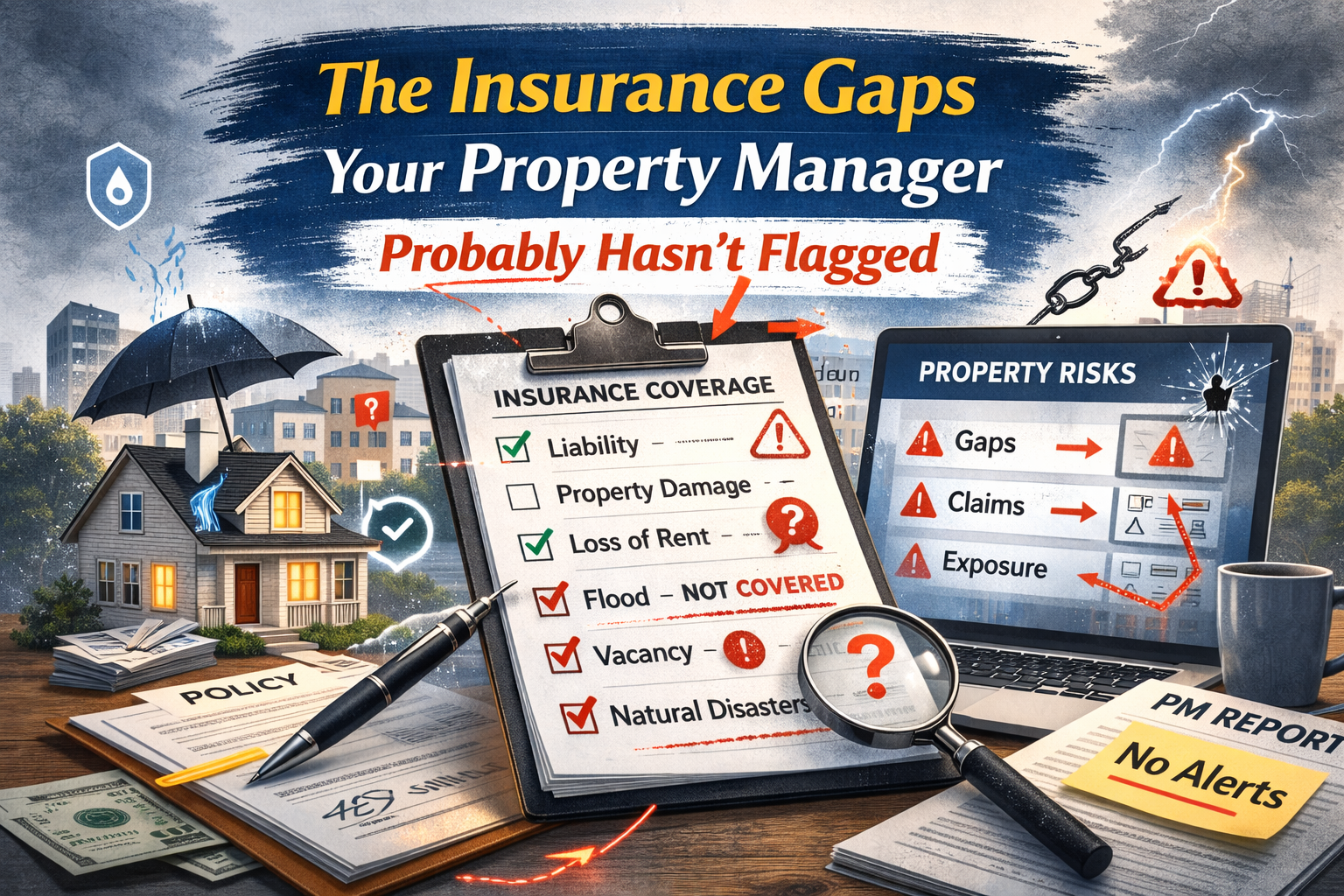
The False Sense of Security
Your property manager sends you a message: “Insurance certificate for property #3 is current. Valid through June 2025.”
You breathe easier. Box checked.
But what you don’t know:
- The policy has a $300,000 liability limit, and your property is in a high-litigation state
- Flood coverage is excluded (and the property is in a flood-prone area with climate risk accelerating)
- Loss of rent coverage caps at $5,000/month, but your actual rent is $3,500 (seems fine, but a multi-month vacancy would exceed this)
- The policy lists the mortgage company as the insured, but not you as the owner (meaning the claim could be denied if the lender’s interest differs from yours)
- Replacement cost coverage was downgraded to actual cash value to save premium
- The policy was written under the LLC, but the deed is in your personal name (coverage mismatch)
Your PM didn’t flag any of this because property managers don’t audit coverage adequacy. They confirm existence.
That’s a critical distinction.
What Property Managers Actually Do (And Don’t Do)
A professional property manager’s insurance role typically includes:
What they do:
- Maintain a certificate of insurance from the tenant’s renter’s policy
- Ensure your landlord policy is current and in force
- Track insurance renewal dates
- Provide certificate of insurance to lenders if required
- Report damage and file claims for the property
What they usually don’t do:
- Audit whether coverage limits are adequate for the property’s actual exposure
- Verify that coverage aligns with the deed structure (individual vs. LLC vs. entity)
- Check that all exposures are covered (or at least all gaps are disclosed)
- Review the policy for common exclusions that might apply to your property
- Compare coverage levels across your portfolio to identify inconsistencies
- Flag emerging risks (climate change, rising litigation, etc.)
Most PMs are not insurance professionals. They rely on you to maintain appropriate coverage and on the landlord’s insurance agent to recommend adequate limits.
The problem: Neither you nor the PM is formally checking. It falls into a gap.
Common Insurance Gaps That Don’t Get Flagged
1. Liability Limits Are Too Low
Standard landlord policies offer $300,000-$500,000 in liability coverage. This covers:
- A tenant slips and falls
- A guest is injured on the property
- Someone is injured due to negligent maintenance
In high-litigation states (California, Texas, Florida, New York), jury awards regularly exceed $1 million. A $300,000 limit provides false comfort.
Example scenario:
- A tenant’s guest slips on a wet staircase and suffers a serious back injury
- Jury awards $800,000
- Your policy pays $300,000
- You’re personally liable for $500,000
Your PM never mentions that your limit might be inadequate for your property type and location.
Solution: Umbrella or excess liability coverage (typically $1-2 million at a modest premium). Cost: $150-400/year. Almost no one has this.
2. Flood Coverage Is Missing
Standard homeowners and landlord policies don’t cover flood. You need a separate flood policy through the National Flood Insurance Program (NFIP) or a private insurer.
Flood-prone areas require flood insurance by lender mandate. But what about areas that aren’t officially in a flood zone but are experiencing increased flooding due to climate change?
Examples:
- Your property is in Zone X (minimal flood risk). Climate data shows a 40-year flood happening every 20 years now. Your $0 flood premium looks bad in hindsight.
- Your property is near a river. It’s been 30 years since the last flood. You’ve never had a loss. Insurance seems wasteful.
- Your property is in a flood-prone area, but you’ve had the policy for 10 years without a claim. You’ve stopped renewing it to save $1,000/year.
When a flood happens, you discover the gap. And flooding is increasing in frequency and severity. Your PM doesn’t flag this because they’re managing properties, not forecasting climate risk.
Solution: Review your property’s flood risk (use FEMA flood maps, but also look at climate projections and local history). If there’s any material risk, get flood coverage.
3. Loss of Rent Coverage Is Insufficient
When a property becomes uninhabitable (due to fire, major damage, water intrusion), you can’t collect rent. Landlord policies include loss of rent coverage, which pays a monthly allowance to cover lost income during repairs.
The cap is usually $3,000-5,000/month. For many properties, this is fine. But:
- A $4,000/month rental property with a $3,000 loss-of-rent cap means you’re short $1,000/month
- A major loss (fire, structural damage) could take 6-12 months to repair
- If you’re short $1,000/month × 8 months = $8,000 out of pocket, plus mortgage and other costs
And that’s assuming the coverage actually applies. Some policies cap loss of rent at a percentage of the dwelling coverage limit. A $150,000 dwelling limit with 20% loss of rent = $30,000 total, divided across months. If repairs take 8 months, that’s $3,750/month—possibly adequate, possibly not.
Your PM doesn’t track the relationship between your rental income and your loss-of-rent coverage. They just confirm the policy exists.
Solution: Match loss of rent coverage to your actual monthly rent (or at least 80-90% of it). This usually costs an extra $20-40/year.
4. Replacement Cost vs. Actual Cash Value
Your policy covers the building. But how much does it cover, and in what way?
- Replacement cost: Insurance pays what it costs to rebuild/replace today, accounting for inflation
- Actual cash value (ACV): Insurance pays replacement cost minus depreciation
Example:
- A 25-year-old roof costs $8,000 to replace
- Replacement cost policy: Pays $8,000
- ACV policy: Pays $8,000 × 40% = $3,200 (depreciated 60%)
For older properties, ACV can severely undervalue rebuilding needs.
Most modern policies are replacement cost. But some budget policies shift to ACV to save premium. A $200/year savings sounds good until you need to rebuild and realize you’re $5,000 short.
Your PM doesn’t flag this because they’re not analyzing policy language.
Solution: Verify you have replacement cost coverage, not ACV. If cost is a concern, it’s better to increase the deductible ($2,500 instead of $1,000) than to downgrade to ACV.
5. Entity Name Mismatch (LLC vs. Personal Name)
You own property in an LLC for liability protection. Your mortgage is in the LLC. Your deed is in the LLC.
But your insurance policy was written under your personal name.
This creates a coverage problem. If a claim arises, the insurer might deny coverage because the insured party (you, personally) doesn’t own the property (the LLC does). The insurer’s obligation is to the named insured, not to the property owner.
Conversely, if the policy is correctly in the LLC’s name, but the deed is still in your personal name, you have a mismatch in the opposite direction.
Your PM holds the certificate and confirms the policy is “in force.” But they didn’t verify the entity structure matches the deed.
This is especially critical for investors with multiple LLCs, each owning different properties.
Solution: Verify that the named insured on the policy matches the owner of record on the deed. Work with your insurance agent and attorney to align these before buying—not after a loss.
6. Certificate of Insurance Is Stale
Your PM has a certificate of insurance on file. But certificates don’t automatically update when policies renew. An outdated certificate might say the policy is valid through June 2024—but you’re now in March 2025.
A stale certificate can cause problems if:
- A lender requests proof of coverage
- A claim is filed
- You’re refinancing and the lender asks for current proof
Your PM doesn’t automatically receive updates. The agent has to send them. If there’s a gap in communication, your PM might have stale documentation.
Solution: Request fresh certificates annually, 30 days before your policy renewal date. Set a reminder and make it a standard process.
7. Umbrella/Excess Liability Is Non-Existent
We touched on this above, but it deserves emphasis. Umbrella or excess liability coverage is cheap and critical.
A standard landlord policy provides $300,000-$500,000 in liability coverage. An umbrella policy gives you $1-2 million in additional coverage.
Cost: $150-400/year for $1 million in excess liability.
Return on investment: Potentially infinite (the difference between bankruptcy and solvency in a catastrophic claim).
Yet most individual investors don’t have it. Most PMs don’t recommend it. It’s not on their checklist.
Solution: Add umbrella coverage as a standard part of your insurance program. For a multi-property investor, it’s non-negotiable.
Building Your Own Insurance Audit
You can’t rely on your PM to catch these gaps. Here’s a process:
Step 1: Get Copies of Your Policies
Ask your PM or insurance agent for the full policy documents (not just the declarations page). Read them. Yes, actually read them.
Pay attention to:
- Coverage limits for liability, property, loss of rent
- Exclusions (flood, earthquake, etc.)
- Deductibles
- Named insured (does it match your deed?)
- Entity structure (individual, LLC, corporation)
Step 2: Create an Insurance Inventory
| Property | Address | Coverage Type | Limit | Deductible | Renewal Date | Umbrella Covered |
|---|---|---|---|---|---|---|
| #1 | 123 Oak St | HO5 Landlord | $300K | $1K | June 2025 | No |
| #2 | 456 Elm St | HO5 Landlord | $500K | $2.5K | Dec 2025 | Yes |
| #3 | 789 Maple | HO5 Landlord | $300K | $1K | Sept 2025 | No |
This lets you see at a glance:
- Which properties are under-insured relative to others
- Which renewal dates are coming up
- Whether umbrella coverage is consistent
- Whether deductibles vary without reason
Step 3: Compare to Benchmarks
Research standards for your property type and location:
- Is $300K liability adequate for a multi-unit building? Probably not.
- Is flood coverage required or recommended? Check FEMA maps and local history.
- Is loss of rent coverage sufficient? Compare to your actual monthly rent.
- Is replacement cost included? Confirm.
Step 4: Consult an Insurance Professional
Don’t rely on a property manager or a captive insurance agent (one who works for one company). Talk to an independent insurance broker who serves real estate investors.
Ask:
- “For a portfolio of X properties in Y state, what coverage should I have?”
- “What gaps do you see in my current coverage?”
- “What’s the cost to add umbrella coverage?”
- “How should I handle the flood risk on property #3?”
A good broker will flag issues your PM missed.
Step 5: Document and Review Annually
Keep a folder (digital or physical) with:
- Current policy declarations pages
- Proof of renewal
- Broker recommendations
- Coverage analysis
Review annually. Insurance needs change as property values change, as your portfolio grows, and as climate risk evolves.
The Liability You’re Accepting
Here’s the uncomfortable truth: When something happens—a tenant is injured, a fire spreads to a neighbor’s property, a flood causes damage—you’re ultimately liable.
Your PM can help manage the property, but they can’t protect you from underinsurance. That’s your responsibility.
Some investors assume their lender’s requirements are sufficient. Lenders require coverage, but they only require enough to cover the mortgage balance—not enough to cover your liability or your equity.
Others assume their homeowner’s insurance agent knows about rental property best practices. Many agents are generalists. Landlord insurance is a niche, and not all agents specialize in it.
And most assume their PM is auditing coverage. PMs are property managers, not insurance professionals.
So coverage gaps persist. Until they don’t—until a loss happens and you discover that your “insurance” doesn’t actually cover it.
Building a Proactive Insurance Program
The investors who sleep best are those who:
- Understand their coverage - They’ve read their policies, not just received certificates
- Have professional guidance - They work with an insurance broker who specializes in rental properties
- Review annually - They revisit coverage as the portfolio changes
- Close known gaps - They add umbrella coverage, flood coverage, and loss-of-rent coverage proactively
- Document everything - They maintain a central record of all policies and renewals
- Verify alignment - They ensure entity names, deed structures, and policy names all match
Your PM is not equipped to do this. It’s your job.
DoorVault helps you track insurance alongside all your other portfolio data. Knox AI flags missing renewals, aggregates coverage information, and surfaces gaps (mismatched entity names, missing flood coverage, low limits) so you can work with your insurance broker to close them. Insurance oversight becomes part of your broader portfolio intelligence—visible, tracked, and actionable.